New Methodologies for Surveying Language Shift
in the Republic of Chuvashia, Russia

Here I am with President Neil Kerwin (to the right of me), and all the other Fulbright winners from American University: Doug Keillor (Mexico), Grant Livingston (Taiwan), Emily Pfefer (UK), Natassia Rozario and Maria Ramirez.
|
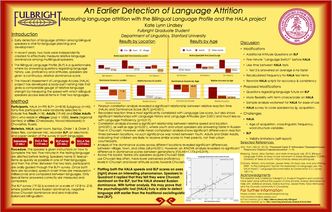
Abstract: Early detection of language attrition among bilingual speakers is vital for language planning and development.
In recent years, two easy-to-use tools were independently created to effectively measure relative language dominance among multilingual speakers. The Bilingual Language Profile (BLP) is a questionnaire, where by answering questions regarding language history, use, proficiency and attitudes, speakers are given a continuous, relative dominance score. The Hawai‘i Assessment of Language Access (HALA) project has developed a body-part naming task that gives a comparable gauge of relative language strength by measuring the speed with which bilingual speakers access lexical items in their two languages. By using these tools simultaneously, not only did I find that they indeed appear to be measures of the same phenomenon, but also that the HALA tool was able to detect language shift much earlier than the more traditional BLP method. In this paper, I discuss both methodologies, their results, and my suggestions for improvement in the Chuvash context. |
